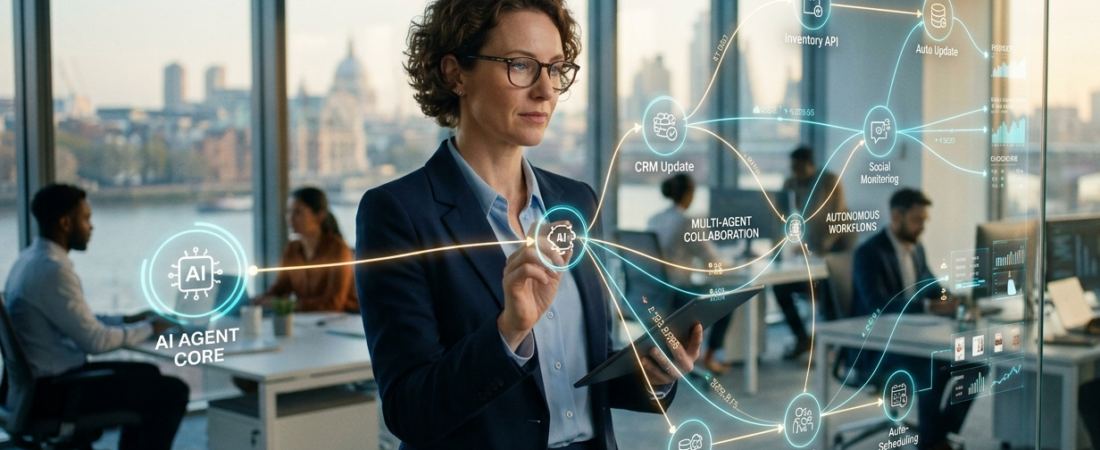
If you have spent the last few years chatting with artificial intelligence to clear up doubts, summarize texts, or generate emails, get ready for a drastic change. The classic question and answer format — where you type a prompt and passively wait for a response — is becoming obsolete. We are living through the transition from chatbots to AI Agents: systems designed not just to answer, but to get the work done.
Instead of just suggesting a spreadsheet, AI now fills in the data, analyzes the results, sends the report to your team, and schedules the alignment meeting completely autonomously. Welcome to the era of intelligent workflows.
From Passive Assistants to Active Agents: What Changed?
To understand the impact of this evolution, we need to differentiate the artificial intelligence we have grown used to from the one that is transforming the market right now:
The Traditional Chatbot (Previous Generation): Depends 100% on human commands for every single step. It operates as a reactive copilot. You need to validate, copy, paste, and execute each command in isolation.
The AI Agents (The Current Reality): They possess autonomy, long-term memory, and the ability to use tools. You only define the final goal (such as: “Organize the logistics for the launch of product X”), and the agent autonomously plans the necessary steps, accesses the internet, uses APIs, integrates with Slack, Trello, or internal systems, and executes the task from start to finish.
The Power of Collaboration: Multi-Agent Systems
The great leap in productivity and sophistication happens when we start putting “agents to talk to agents”. Instead of a single, centralized artificial intelligence trying to solve complex and multifaceted problems, modern companies are utilizing specialized and collaborative ecosystems:
- Research Agent: An agent specialized in market research that collects data and trends in real time.
- Analytical Agent: It passes this information along to an agent focused on financial analysis, which projects scenarios and calculates risks.
- Creative Agent: This one, in turn, delivers the processed results to a writing and design agent, which creates the final executive presentation.
The role of the human being in this scenario? You stop being a manual executor and become a strategic supervisor: reviewing, calibrating, and giving high-level direction to the digital ecosystem.
Practical Examples in the Professional Daily Routine
AI agents have already left the research labs and are operating in the real market:
Sales and Support: Agents that not only converse with customers in a humanized way, but also check inventory in real time, process refunds directly in the financial system, and update the CRM history without any human intervention.
Digital Marketing: Autonomous tools that monitor trends on social media 24 hours a day, create personalized ad campaigns, adjust budget bids predictively, and generate weekly reports focused on ROI.
Software Development: Autonomous software engineers (such as AI-powered agents) that proactively find bugs in the source code, apply the necessary fixes, and perform complex stress tests on their own before human approval.
Conclusion: The New Role of the Professional
The rise of AI agents does not mean the end of human work, but rather the definitive evolution of our strategic role. We are moving away from being mere executors of repetitive, bureaucratic, and operational tasks to take on the position of directors, orchestrators, and strategists.
In today’s market, the most valuable and sought-after professional will not be the one who only knows how to type quick prompts, but rather the one who learns how to manage, orchestrate, and delegate complex functions to these autonomous agents.
Leave your comment!
Do you already use any tool with autonomous agents in your daily work routine or are you still completely stuck in the traditional chatbot format? Share your experience down below!